
The spine is a wondrous network of bones, discs, facet joints, ligaments, spinal nerves and muscles, all combined and connected in an incredibly complex way to provide both stability and wide range of movement. The spine is actually a series of joints, joints that sometimes need help functioning as they are intended. Keeping this system mechanically aligned and held snuggly together allows for healthy function and pain-free movement. When optimal function is compromised, spasms, tightness, and pressure on nerves result.
Many episodes of low back pain pass within a few weeks to a month (acute episode). However, individuals with continuous pain lasting 8 weeks or more after onset (chronic episode) will often have symptoms at 1 year. Pain doesn’t always develop immediately following an injury because the body is good at adapting to strains and stress. However, the injured area will cause strain to build up over time and eventually symptoms will develop. This is why injuries from the past can still cause current pain. Symptoms can include muscle ache, shooting or stabbing pain, pain that radiates down leg or arm, limited flexibility.
Osteopathic Manipulation
Osteopathic Manipulative Treatment (OMT) focuses on correcting mechanical dysfunction. Structural integrity allows these complex joints to function as they were designed, reducing irritation, inflammation and pain. Healthy function improves blood flow to nourish tissue and further reduce inflammation. Strain on surrounding body tissue caused by compensation is reduced preventing further complications. OMT addresses the root biomechanical causes of injuries and conditions to alleviate pain and restore optimal function of the body.
Osteopathic Manipulative Therapy (OMT) helps to:
- Correct structural and tissue abnormalities in vertebrae, muscles, myofascial structures, etc.
- Relieve joint restriction and misalignment
- Restore muscle and tissue balance
- Promote the movement of bodily fluids
Look well to the spine for the cause of diseases. -Hippocrates
Regenerative Orthopedics
The spine is no longer able to hold in place the protective discs between vertebrae. Surrounding tissue becomes inflamed, causing further joint damage. Medical research has discovered ways to maximize the oldest form of healing: your own body. By understanding how the healing process actually occurs, physicians are able to enhance the natural physiologic process of cell replacement.
Ligaments in the back, as elsewhere in our body, are designed to handle a normal amount of stress that will stretch them to their natural limit. Once the stress is removed, the ligaments will return to their normal length. When excess stress is applied, stretching the ligament beyond its natural range of extension, the ligament will not return to its normal length. Instead, it will remain permanently “over-stretched,” diminishing its ability to hold the vertebrae in their proper place. Such a condition is called “ligament laxity.” Regenerative procedures can strengthen the connecting tissues to make the spinal column more stable, reducing friction and inflammation that cause back pain and often lead to osteoarthritis.
Healthy function of joints is controlled by mesenchymal stem cells that regulate replacement of damaged cells, modulate inflammation, and stimulate cell growth. Mesenchymal stem cells are able to differentiate into multiple forms of musculoskeletal tissue, such as bone, cartilage, tendons and ligaments. When the balance between the supply of new cells is adequate to maintain healthy function, the body is in homeostasis. However, imbalance in this function leads to degeneration of tissue, such as osteoarthritis. Read more.
Orthopedic Procedures
Platelet Rich Plasma (PRP), Prolotherapy, and Stem Cell Therapy are regenerative procedures that help heal collagenous tissue, such as tendons, ligaments, and cartilage.
Natural forces within us are the true healers of disease. ―Hippocrates
Cervical Spine Pain Decrease After Regenexx Procedure
Cervical pain decrease:
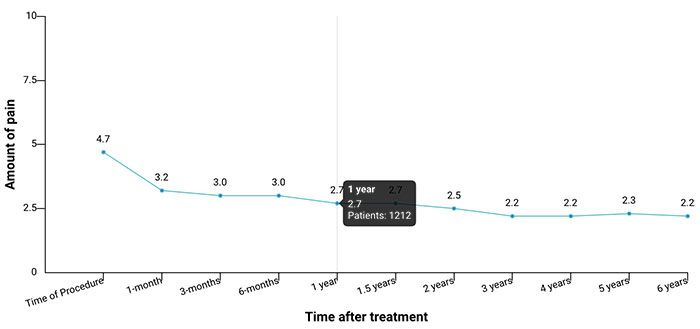
Prior to receiving treatment, patients report average pain of 4.7/10. One month after treatment, pain levels decrease to an average of 3.2/10, a decrease of 32%. The questionnaire used is the Numeric Pain Scale (NPS).
Cervical function improvement:
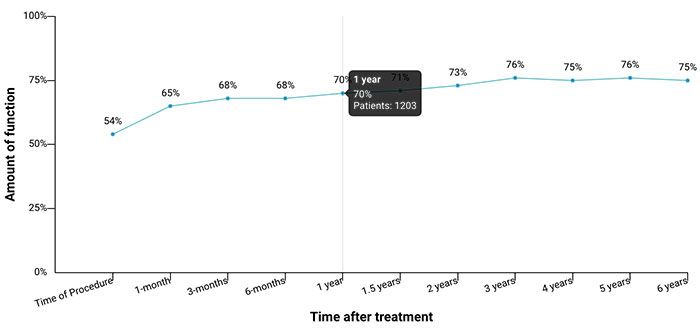
Prior to treatment, patients report being limited to an average of 54% of their optimal function. After receiving treatment, they report averages up to 75%. The functional questionnaire represented here is the Functional Rating Index (FRI).
Lumbar Spine Outcomes
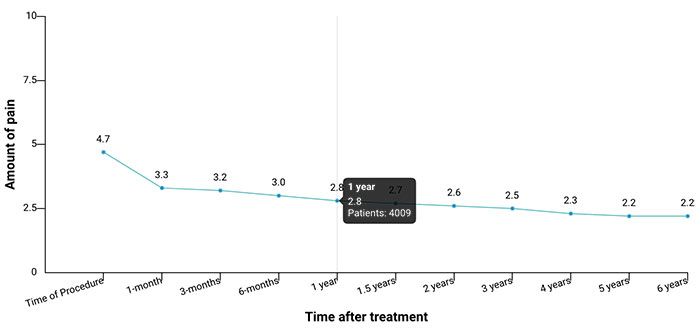
Lumbar pain decrease: Prior to receiving treatment, patients report average pain of 4.7/10. One month after treatment, pain levels decrease to an average of 3.3/10, a decrease of 30%. The questionnaire used is the Numeric Pain Scale (NPS).
Lumbar function improvement:
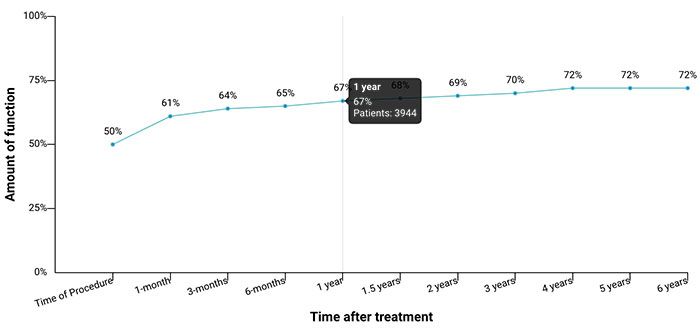
Prior to treatment, patients report being limited to an average of 50% of their optimal function. After receiving treatment, they report averages up to 72%. The functional questionnaire represented here is the Functional Rating Index (FRI).
Orthopedic Procedures
Platelet Rich Plasma (PRP), Prolotherapy, and Stem Cell Therapy are regenerative procedures that help heal collagenous tissue, such as tendons, ligaments, and cartilage. Ligaments in the back, as elsewhere in our body, are designed to handle a normal amount of stress that will stretch them to their natural limit. Once the stress is removed, the ligaments will return to their normal length. When excess stress is applied, stretching the ligament beyond its natural range of extension, the ligament will not return to its normal length. Instead, it will remain permanently “over-stretched,” diminishing its ability to hold the vertebrae in their proper place. Such a condition is called “ligament laxity.” Regenerative procedures can strengthen the connecting tissues to make the spinal column more stable, reducing friction and inflammation that cause back pain and often lead to osteoarthritis.
Natural forces within us are the true healers of disease. ―Hippocrates
Regenexx is a world-wide network of select, highly skilled physicians who are specially trained in interventional procedures for orthopedic conditions.
Common conditions causing back pain
Ligament strain. Injury occurs when ligament tissue is over-stretched or torn, resulting in damage to the ligament fibers (tough, fibrous tissues that connect the bones together). A strain that occurs in the lumbar region of the back is referred to as a lumbar strain. Ligament laxity of overstretched tissue results in mechanical dysfunction and inflammation of surrounding tissue. Muscles and tissue surrounding the strain will attempt to compensate for the instability. These conditions lead to back spasm that can cause both severe lower back pain and difficulty moving.
Bulging or ruptured discs. Discs act as cushions between the bones (vertebrae) in the spine. The soft material inside a disc can bulge or rupture and press on a nerve. However, a bulging or ruptured disc can occur without back pain. Disc disease is often found incidentally during spine X-rays given for another reason.
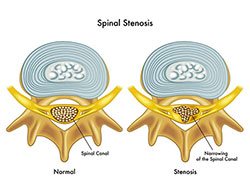
Spinal stenosis. Spinal stenosis is narrowing of spaces in the spine, causing pressure on the spinal cord and nerves that travel through the spine to the arms and legs. Most cases occur in the lumbar region of the back and are often caused by the wear and tear related to osteoarthritis.
Skeletal irregularities. Back pain can occur if the spine curves abnormally. Scoliosis, a condition in which your spine curves to the side (laterally), also may lead to back pain, but generally only if the scoliosis is severe.
Irritation of large nerve roots that travel to the legs
Irritation of smaller nerves in lower back
Sprain. Tendons attaching the muscles to bones and can become sprained with excess force resulting in a sprain. The large paired lower back muscles (erector spinae) can also become sprained, often resulting in small tissue tears.
Degenerative disc disease. Narrowing of the discs between vertebrae causes compression of the nerves extending through the vertebral canal often resulting in tissue degeneration.

We Can Help
To learn more about what we can do to help with your condition, call our office at 817-416-0970. We will thoroughly diagnose your condition and present you with treatment options. From there we will guide you along your road to recovery.
Regenexx provides the world’s most advanced, research-driven, regenerative orthopedic procedures in North America, Europe, the Middle East, Asia and Australia. Specializing in advanced non-surgical procedures for joint Injuries, osteoarthritis, and other orthopedic conditions, Dr. Minotti brings these procedures to you!